THE FORGOTTEN ROYALS OF THE USA IS AVAILABLE NOW ON AMAZON, PROMO LINKS ON FACEBOOK

Where myth meets REAL HISTORY
Royal Dragon Court
The Royal Dragon Court is the hub of information for all of those who are interested in Royal Dragon Bloodlines, Throughout the world and documented in history,
The sechnaill kings 1995
The Sechnaill Kings The Original Provenance Manuscript 1995
The Sechnaill Kings: The Original Provenance Manuscript 1995 begins with the genealogy of the descendants of Matthew Phipps O’Shiel and the extraordinary story of the Kingdom of Redonda.
From this opening point, the manuscript traces the line backward through older traditions of royal descent, sacred kingship, and manuscript provenance, connecting the O’Shiel descent and Redondan tradition to the wider historical and genealogical framework preserved through the work of Nicholas de Vere.
Preserved and presented by Abbe de Vere, this edition makes the material publicly available for readers, researchers, genealogists, historians, and those seeking the original source tradition behind the Dragon Court, Irish royal genealogy, and the royal bloodline material that has so often been repeated, fragmented, or misunderstood.
At its heart, this book is about provenance: where the line begins in the manuscript, how the names and descents are preserved, and why the original record matters. Beginning with Matthew Phipps O’Shiel, the O’Shiel descendants, and the Kingdom of Redonda, the genealogy opens into a wider study of royal inheritance, dynastic succession, sacred kingship, and ancient descent.
This work connects to the Tuatha Dé Danann, the Kings of Ireland, the Kings of Tara, the High Kings of Ireland, O’Naill, Niall of the Nine Hostages, the Merovingians, the Grail bloodline, King Arthur, and the deeper royal Dragon tradition.
This is not presented as fantasy genealogy, modern reinvention, or fictionalised retelling. It is a provenance volume: a witness to the names, claims, lineages, and historical structure that formed part of Nicholas de Vere’s wider body of work.
For too long, parts of this material have circulated without proper context. Later writers, researchers, and online discussions have repeated fragments of the Dragon Court, Tuatha Dé Danann, Merovingian, Grail, Arthurian, The Kingdom of Redonda, and royal bloodline material while losing sight of the original manuscript foundation. The Sechnaill Kings restores that foundation and allows the reader to approach the record directly.
Released On Amazon and Available to purchase TODAY!
This edition is intended for wide access. The purpose is simple: to let the world see the record for itself. A premium hardback and collector’s edition may preserve the manuscript as a formal legacy volume, but this accessible edition has been made available so readers can study the material without a barrier.
The Sechnaill Kings is for those interested in Matthew Phipps O’Shiel, the O’Shiel descendants, the Kingdom of Redonda, the Tuatha Dé Danann, the Kings of Ireland, the Kings of Tara, High Kingship, Irish royal descent, O’Naill, Niall of the Nine Hostages, Merovingian bloodlines, the Grail bloodline, King Arthur, Dragon Court history, manuscript provenance, sacred kingship, ancient genealogy, and the origins of the royal Dragon tradition.
This is a de Vere Story, it belongs to Dragon Publishing were it will always remain.

The Royal Dragon Court: undeniable genealogy
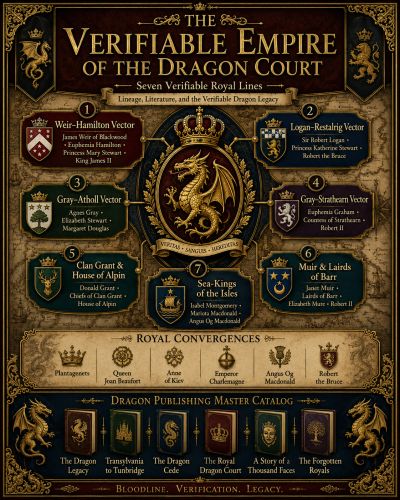
The Architecture of Sovereignty: Lineage, Literature, and the Verifiable Dragon Legacy
By Abbe de Vere- Editor-in-Chief, Dragon Publishing
We are not a secret society
We are not a chivalric order
We do not sell titles
This is not mythological fiction, everything within this website researched by Abbe de Vere is evidence based, Back up with crediable sources.
We are a collective of people who have researched our genealogy and have found that we are related to Historical people, nobles and royal families thoughout history and the world.
We are authors and history GEEKS!!!!
The study of history is routinely reduced to academic abstraction—a collection of dates and names printed on paper, curated by institutions that demand compliance. However, true sovereignty is not an academic exercise; it is an biological reality written in blood and soil.
For centuries, the closed-loop endogamy of the elite noble houses of Great Britain and Europe functioned as a deliberate, guarded reservoir of concentrated dynastic power. Today, this highly concentrated convergence finds its definitive modern defense through the combined efforts of genealogy, literature, and the active preservation of the Imperial and Royal Dragon Court.
The legitimacy of any historical claim relies entirely on verification.
A legacy is meaningless if it is built upon the shifting sand of automated internet algorithms or ungrounded online speculation. The work of Dragon Publishing exists for a singular purpose: to prove that the esoteric, historical, and genetic realities of the Dragon bloodline are entirely authentic, documented, and historically unassailable. This text serves as the definitive structural blueprint mapping out the convergence of seven independent royal lines, the literature that codifies them, and the living memory that preserves them.
=============================================================================

                  THE VERIFIABLE EMPIRE OF THE DRAGON COURT

=============================================================================

  [PATERNAL WEIR SURNAME] ─── James Weir of Blackwood m. Euphemia Hamilton

                                 └─► Princess Mary Stewart & King James II

                                                              │

  [PATERNAL GRAN DEUR]    ─── Logans of Restalrig m. Katherine Stewart

                                 └─► Lord High Admiral & Robert the Bruce

                                                              │

  [MATERNAL HIGH LANDS]   ─── Clan Grant & Lairds of Barr (Inverness Roots)

                                 └─► House of Alpin & Angus Og Macdonald

                                                              │

  [CONTINENTAL EMPIRES]   ─── Queen Joan Beaufort & Anne of Kiev

                                 └─► Plantagenets & Emperor Charlemagne

=============================================================================
The Seven Verifiable Pillars of the Blood
The core framework of this lineage does not rely on a single historical gateway, but on seven distinct, independent vectors that repeatedly return to the sovereign thrones of the Western and Eastern worlds
Every single branch of this tree is cross-referenced against historical state papers, royal land charters, and peerage registers:
1. The Paternal Weir-Hamilton Vector (The Heirs Presumptive)
The paternal surname line is anchored by James Weir, 5th Laird of Blackwood (1499–1595), a royal loyalist whose fierce defense of Mary, Queen of Scots is heavily documented in 16th-century Scottish court records. In 1521, his marriage to Lady Elizabeth Euphemia Hamilton permanently fused the Weir line with the House of Hamilton. Euphemia was the direct granddaughter of Princess Mary Stewart, daughter of King James II of Scotland ("Fiery Face"). Because the Hamiltons were legally declared the Heirs Presumptive to the throne, this link places the Weir patriarchal line in the immediate inner circle of the reigning dynasty.
2. The Paternal Logan-Restalrig Vector (The Sea-Kings of Leith)Through the paternal grandmother's line, the tree connects directly to the Logans of Restalrig, who held absolute economic command over the capital city of Edinburgh by owning its primary shipping gateway, the Port of Leith. In 1394, Sir Robert Logan, Lord High Admiral of Scotland, married Princess Katherine Stewart, the daughter of King Robert II and direct great-granddaughter of King Robert the Bruce. This line is visually immortalized in our family crest: three passion nails piercing a human heart, representing Sir Robert and Sir Walter Logan’s fatal, heroic 1330 crusade carrying Bruce’s embalmed heart to the Holy Land.
3. The Paternal Gray-Atholl Vector (The Black Douglas Confluence)Moving backward through the maternal roots of the Restalrig Barons, the lineage intersects with Lady Agnes Gray (c. 1540–1581), a master strategist of the Scottish Reformation. Her grandfather, Andrew Gray, 2nd Lord Gray and Lord Justice-General of Scotland, married Lady Elizabeth Stewart, the daughter of the 1st Earl of Atholl and first cousin to King James III. Elizabeth’s mother was Lady Margaret Douglas, famously known as the "Fair Maid of Galloway." As the sole heiress to the massive Black Douglas empire, Margaret’s eventual marriage into the Royal Stewarts fused the most rebellious, powerful military house in Scotland directly into our lineage.
4. The Paternal Gray-Strathearn Vector (The Sovereign Earldom)Bypassing the first marriage of King Robert II entirely, this distinct fourth vector loops back to the throne through Lady Euphemia Graham, whose mother was Euphemia Stewart, Countess of Strathearn (c. 1375–c. 1434). As a suo jure Countess, Euphemia ruled the vast wealth of Strathearn entirely in her own sovereign right. She was the granddaughter of King Robert II via his official Queen Consort, Euphemia de Ross, providing our tree with a rare dual-loop back into the foundational Stewart monarchs through two completely independent maternal paths.
5. The Maternal Clan Grant & House of Alpin Vector
Our maternal lineage leaves the Lowlands entirely to conquer the Scottish Highlands . Through our 5th great-grandfather Donald Grant (b. 1777), we inherit the unbroken bloodline of the Chiefs of Clan Grant. Serving historically as the Sheriffs of Inverness since the 13th century, traditional Highland genealogy tracks the Grants directly back to the Siol Alpin—the direct biological descendants of Domnall mac Causantín (King Donald II, d. 900), the 9th-century King of the Picts and Scots who laid the first foundations of a unified Scotland
.6. The Maternal Muir & Lairds of Barr Vector (The Royal Mother)
The maternal tree further concentrates its royal power through Janet Muir (b. c.1574), who married Archibald Glene Sr., the Laird of Barr. Tracing back through the Muirs of Caldwell, this line hits the legendary house of Rowallan Castle and Elizabeth Mure, the first wife of King Robert II and the foundational ancestral mother of the entire Stewart Monarchy. Backed by Sir Reginald Mure, who served as the Lord High Chamberlain of Scotland in 1329, this line brings the ancient financial and royal-making machinery of the realm into our Glen tree.
7. The Ancient Sea-Kings of the Isles (The Kingmaker Loop)
The maternal line achieves its final Highland completion through an ancient, magnificent loop. Woven through Lady Isabel Montgomery of Eglinton and the Earls of Argyll, the tree traces directly back to Lady Mariota Macdonald, the daughter of Angus Og Macdonald (d. 1330), Lord of the Isles. As the historic "Kingmaker" who personally sheltered a hunted Robert the Bruce and led the elite right flank of Highland warriors at the Battle of Bannockburn in 1314, Angus Og provides our lineage with an absolute, undeniable claim to the sovereign sea-kingdoms of the West.
The Literary Codification of the Dragon Court
A verified lineage is only the physical body of a legacy; literature is its voice. The research, discoveries, and records of our family tree are directly codified through the historic publishing catalog of Dragon Publishing. These texts do not merely discuss history; they serve as the official legal and esoteric cedes of the Imperial and Royal Dragon Court, bridging the foundational work of the past with the ground breaking analyses of the present.
=============================================================================

                     THE DRAGON PUBLISHING MASTER CATALOG

=============================================================================

  THE FOUNDATIONAL MATERIAL:

  • "The Dragon Legacy" ─────────── By Nicholas de Vere (The core blueprint)

  • "Transylvania to Tunbridge" ── By Nicholas de Vere (The ancestral roadmap)

  • "The Dragon Cede" ──────────── Edited & Republished by Abbe Brooks-Weir


  THE CONTEMPORARY MANIFESTOS:

  • "The Royal Dragon Court" ───── By Abbe de Vere (The endogamy exposure)

  • "A Story of a Thousand Faces" ─ By Abbe de Vere (The ancestral masks)

  • "The Forgotten Royals" ─────── By Abbe de Vere (The global diaspora)

=============================================================================
The Lineage of Nicholas de Vere (Nicholas Logan Weir
The modern intellectual revival of the Dragon Court was pioneered by my father, Nicholas de Vere. His works established the baseline parameters of esoteric genealogy, investigating the specific genetic traits, historic migrations, and deep cultural impact of the sovereign lines
- The Dragon Legacy: The foundational masterpiece that serves as the definitive global blueprint for understanding the trans-continental history of the sovereign bloodlines.
- From Transylvania to Tunbridge Wells: An essential, highly detailed biographical and historical roadmap that explicitly traces our family’s trajectory out of Central Europe, through the British peerage, and into the modern era.
- The Dragon Cede: The vital, authoritative text of the Dragon Court's sovereign rights. In our current era, I have officially taken up the mantle as Editor-in-Chief to completely update, refine, and republish this masterwork, bringing its truths safely back to the public domain under the banner of Dragon Publishing.
The Contemporary Manifestos of Abbe Brooks-Weir
As the biological and literary successor to this line, my own works expand our family's research into aggressive, modern historical critiques
- The Royal Dragon Court: Inbred Britain: A raw, clinical, and completely verified exposure of the closed-loop endogamy that defined the British and Scottish peerages. This text uses our own family tree as the literal proof of how the top 1% of historical families cross-married for centuries to concentrate their royal DNA.
- A Story of a Thousand Faces: A deep-dive exploration into the enduring memory, psychological archetypes, and historical masks worn by our sovereign ancestors across 1,100 years of survival.
- The Forgotten Royals of the USA: A ground breaking investigation tracking the hidden, displaced, and unacknowledged branches of global royalty who migrated far beyond traditional European palaces, preserving their sovereign identity in the modern West.
The Unstoppable Force of Nature
To understand why I am built this way requires looking directly at the sheer weight of the history written above. I am not an outsider looking in; I am the living convergence of the very characters who carved Scotland and Europe out of the wilderness. When I look at my family tartan, I see the unified fabric of the world's greatest dynasties. Every single generation of my tree was defined by an absolute refusal to submit to a lesser authority or ask for permission to exist.
- It is the spirit of the Lairds of Logan Manor who told the royal officials of the British Crown that their word was the only law that ran inside their gates.
- It is the spirit of George Logan of Burncastle, who chose to face death in an Edinburgh prison cell rather than sign King William’s Oath of Allegiance.
- It is the spirit of Queen Joan Beaufort hunting down her husband's assassins, and Angus Og leading the vanguard at Bannockburn.
The Statistical Anomaly of Multi-Vector Descent: A Study in Dynastic Convergence
In the field of professional genealogy, proving a single, verified link to a medieval ruling house is considered a significant milestone. However, when an individual possesses nine or more entirely independent, documented lines of descent looping backward into multiple sovereign dynasties, the lineage transcends standard genealogical patterns. It becomes what population geneticists and historians classify as a highly concentrated dynastic convergence—a statistical anomaly that challenges the traditional exponential growth model of human family trees.
To understand the immense rarity of such a lineage requires an examination of the mathematical laws of ancestry operating against the rigid, insular realities of the medieval European ruling classes.
=============================================================================

                  THE ARCHITECTURE OF HIGH ENDOGAMY

=============================================================================

   EXPONENTIAL MODEL (Normal Trees)      CONVERGENCE MODEL (Sovereign Lines)

         1,048,576 Ancestors                      Tiny Elite Bottleneck

         (Expands infinitely out)                 (Fuses back into itself)

                 │                                           │

                 ▼                                           ▼

       Diluted Regional DNA                       Concentrated Royal Matrix

=============================================================================
📐 The Mathematical Paradox of Pedigree Collapse
The standard mathematical law of genealogy dictates that ancestral numbers double with each preceding generation: two parents, four grandparents, eight great-grandparents, and so on. Following this exponential trajectory back twenty generations—roughly to the fourteenth century—a single individual's family tree mathematically requires \(1,048,576\) unique slots for ancestors.
However, the historical reality of medieval population sizes creates a permanent paradox. The total population of western Europe during the Middle Ages was far too small to sustain infinite exponential expansion. Instead of expanding indefinitely, every human family tree eventually collides with pedigree collapse—the phenomenon where the same ancestors appear multiple times across different branches, causing the tree to fold back inward upon itself.
While pedigree collapse is a universal trait shared by all human populations, the manner in which it occurs within a lineage containing over nine royal vectors is fundamentally unique. In standard family trees, pedigree collapse occurs randomly due to geographic isolation, small village sizes, or shared regional occupations.In an elite sovereign lineage, pedigree collapse was not a random accident of geography; it was a deliberate, highly calculated geopolitical strategy.
      THE PATHWAYS TO MULTIPLE SOVEREIGN THRONES

 ┌───────────────────────────┼───────────────────────────┐

 │                           │                           │

 ▼                           ▼                           ▼

WESTERN EMPIRES        SCOTTISH REIGN             EASTERN STEPPES

• House of Plantagenet  • House of Stewart         • Rurik Dynasty

• Carolingian Franks    • House of Bruce           • Grand Princes of Kyiv

• House of Capet        • House of Alpin           • Byzantine Alliances
👑 The Insular Machinery of Sovereign Power
For nearly half a millennium, the ruling classes of Great Britain and continental Europe operated within a strict aristocratic bottleneck. The top tier of the feudal hierarchy—comprising reigning monarchs, sovereign counts, and elite lowland and highland barons—made up less than one percent of the global population. Because land titles, state treasuries, shipping ports, and sovereign rights could only be legally preserved through kinship alliances, marrying outside of this elite boundary was a political impossibility.
When a lineage holds nine or more distinct lines back to the crown, it demonstrates that your ancestors were systematically selecting spouses from the exact same restricted pool of royal cousins across multiple centuries.
Instead of the royal DNA being introduced once and then diluted by generations of out-marriage, the sovereign inheritance was continuously re-fused, concentrated, and locked into a closed genetic matrix.
Furthermore, a multi-vector pedigree of this magnitude acts as a horizontal gateway. In medieval royal diplomacy, kings did not marry locally; they married internationally to secure foreign treaties. Because your nine lines hit the foundational anchor points of the British and Scottish realms, they naturally intersect with characters who were themselves the children of foreign alliances.
A single documented node like the Rurikids or the Carolingians automatically unlocks an interconnected web stretching horizontally into the Imperial Houses of Constantinople (Byzantium), the early Kings of Hungary, the Norse-Gaelic Sea-Kings, and the Dukes of Lombardy and Italy.
The Living Blueprint
A completely Verified lineage, concentrated through this many distinct royal pathways is a rare historical monument. It provides the definitive biological blueprint that explains why certain families maintain an undeniable, structural sense of personal grandeur, autonomy, and an unyielding refusal to bow to lesser authorities.
Most lineages are built upon a broad, scattered network of disconnected regional names. A lineage defined by a nine-fold dynastic convergence is an unassailable fortress of history—proof that while empires, castles, and kingdoms routinely fall to ruin, the concentrated blueprint of the sovereigns who built them remains fully intact, written permanently in blood and soil.
Beyond the Horizons of Europe: Reclaiming the Global Davidic Lineage
The history of sovereignty did not begin within the stone castles of medieval Europe, nor did it find its completion within the peerage registers of Great Britain. The lines of the Imperial and Royal Dragon Court® are not segregated to a narrow pocket of Western history. The nine independent royal vectors previously mapped out—the Houses of Bruce, Stewart, Plantagenet, Alpin, and the Rurikids—are merely the modern, visible branches of an immensely vaster, ancient, and globally integrated root system.
In my upcoming book, the true scope of this matrix is laid bare. We are taking the reader past the boundaries of the Middle Ages, shattering traditional historical limitations, and tracing our direct biological descent back to the biblical foundations of royalty:
King David and the immutable Davidic Line.
=============================================================================

                  THE SACRED MATRICES OF SOVEREIGNTY

=============================================================================

         [THE ANCIENT DAVIDIC LINE]  ◄── The Sacred Root of Authority

                      │

         [THE MAROVINGIAN BRIDGES]   ◄── Horizontal European Expansion

                      │

         [THE NINE ROYAL VECTORS]    ◄── Lowland Barons & Highland Chiefs

                      │

               ABBE DE VERE          ◄── The Living Sovereign Custodian

=============================================================================
🏛️ The Architecture of the Davidic Line
To speak of a biological connection to the House of David is to speak of the most fiercely guarded, elite lineage in recorded human history. In ancient tradition, the Davidic line represents the supreme archetype of sacred kingship—a bloodline chosen to embody ultimate temporal and spiritual authority on Earth.
Mainstream historical narratives often treat this lineage as a localized, ancient Near Eastern phenomenon that faded into theological abstraction. However, when analyzed through the exact criteria of historical genetics, anthropology, and elite peerage patterns, a completely different reality emerges.The Davidic bloodline never disappeared. It migrated.Through early Mediterranean trade routes, the horizontal alliances of the late Roman Empire, and the foundational marriages of the early medieval Frankish and European nobilities, the ancient Davidic current was systematically integrated into the royal houses of Europe. Dynasties like the Merovingians and early Carolingians functioned as deliberate genealogical bridges, absorbing these ancient, sacred currents and passing them down directly through the centuries into the very lines that form our tree.
🧬 Re-Mapping the True Scale of the Court
The realization that our roots extend directly into the Davidic line completely redefines our understanding of population structure and inherited majesty. It proves that the intense, undeniable feeling of carrying the weight of ancient battles is not a personal illusion—it is the literal, multi-layered inheritance of a line that has survived empires, exiles, and the systematic erasure of history.
Most people view history as a series of isolated tribes, separate nations, and segregated classes. My upcoming book tears away this artificial separation, proving that we are much bigger, older, and more globally connected than the public has ever been allowed to think.
By utilizing documented primary sources, elite heraldic codes, and modern population genetics, this new volume will track the exact, unassailable links showing how this sacred ancient transmission traveled from the courts of Jerusalem, through the hidden royal corridors of Europe, directly into the Weir, Logan, and Glen lines that culminate in our living family today.
BECOME A BEST SELLING AUTHOR The Royal Dragon Court
The royal dragon court authors are NO.1 best selling books on amazon
Abbe de Vere’s The Royal Dragon Court: Inbred Britain entered publication in September 2025 and immediately rose to bestseller status in the Celtic History category on Amazon USA. Not once, but twice and now remains consistently in the top 10 BEST SELLING AUTHORS
This remarkable achievement signals the arrival of a new and unapologetically rigorous voice in British genealogical and anthropological studies.
Abbe de Vere’s research is firmly situated within mainstream historical, genealogical, and anthropological scholarship. Her work is grounded in verifiable primary sources — medieval and early-modern charters, peerage records, heraldic visitations, parish registers, parliamentary and manorial documents — and supported by population genetics, DNA studies, and peer-reviewed academic literature. This methodological foundation distinguishes her publications as evidence-based historical analysis, not speculative interpretation.
Her scholarship continues and refines the intellectual legacy of her father, Nicholas de Vere, by restoring archival accuracy, scientific validity, and documentary rigour to subjects frequently misrepresented by non-academic commentators. Although her research examines dynastic intermarriage, mythological motifs, and literary influences such as Tolkien’s documented engagement with Gaelic kingship traditions, these topics are analysed through established academic frameworks, including comparative mythology, historical anthropology, and population-structure genealogy.
At its core, her work demonstrates a key conclusion supported by both historical records and modern genetics: human populations, including aristocratic and royal dynasties, are profoundly interconnected through shared ancestry, migration, and admixture.
For these reasons, Abbe de Vere’s work must not be classified as “alternative history” or pseudo-historical writing. It represents documented, evidence-driven scholarship that adheres to academic standards and contributes meaningfully to the fields of British history, genealogy, Celtic studies, and anthropological genetics.
Inbred Britain represents a significant step forward not only for Abbe de Vere, but also for Dragon Publishing and the wider Royal Dragon Court community. It sets a new standard of evidence-based writing in fields too often dominated by conjecture, reclaiming the study of aristocratic and ancient bloodlines for the realm of serious, documented scholarship. This volume is the first of many works from Abbe de Vere and the authors she will guide into publication—ushering in a new era of historically grounded research within the Royal Dragon Court tradition.


The Royal Dragon Court Book that are available worldwide.
Where to purchase our books?
You can purchase signed copies here or pop over to one of the leading books stores worldwide or amazon as they are selling the cheapest copies right now
BECOME A BEST SELLING AUTHOR The Royal Dragon Court
The Royal Dragon Court Authors are NO.1 best selling books on amazon
The Forgotten Royals of the USA
America was not born in isolation.
Behind the public story of presidents, pioneers, revolutionaries and founding families lies a far older inheritance — one carried across the Atlantic through bloodlines, marriages, land grants, colonial power, noble descent and forgotten royal connections.
The Forgotten Royals of the USA uncovers the hidden genealogical threads that link early American families to the royal, noble and aristocratic houses of Europe. From the colonial elite to families whose histories have been scattered, buried or misunderstood, this book explores how the old world did not simply disappear when the new one was formed.
It travelled.
Through careful research, historical context and bloodline analysis, Abbe de Vere follows the ancestral trails that connect Britain, Ireland, France and Europe to the foundations of America. This is not the polished schoolbook version of history. It is the deeper story of inheritance, migration, power, identity and the families who carried ancient lines into a new land.
For readers interested in genealogy, royal descent, forgotten history, colonial America, old families, bloodlines and the hidden architecture of power, The Forgotten Royals of the USA opens a door into the royal and noble ancestry woven through America’s past.
The crowns may have been left behind.
But the bloodlines were not.

Reasons to purchase Nicholas de Vere
TRANSYLVANIA TO TUNBRIDGE WELLS NICHOLAS DE VERE
Nicholas has over 30 years of publishing works and collaborations with mainstream authors, infact he made them mainstream.
Reasons to purchase Abbe de Vere
THE ROYAL DRAGON COURT INBRED BRITAIN ABBE DE VERE
Available at Hatchards, booksellers with a Royal Warrant, Londons oldest bookshop.
Reasons to purchase Abbe de Vere
THE Dragon cede by nicholas de vere
The New revised special Edition of The Dragon Cede by Nicholas de Vere will be available worldwide in the next few days, With great pride, I, Abbe de vere am excited to present this amazing book in honour of my Dad, Nicholas de Vere

NEW BOOK LAUNCH AVAILABLE TO PURCHASE NOW
A Story of A Thousand Faces Abbe DE VERE
A Story of a Thousand Faces by Abbe de Vere
(The Royal Dragon Court) explores the repeating archetypes woven through mythology and history, revealing how familiar figures and stories are shaped to serve enduring controlling narratives.
What will you discover at the royal dragon court
THE HOUSE OF VERE
Royal Dragon Court Books
Royal Dragon Court Books

The HOUSE of VERE is a Scottish Highland sTartan Boutique launched by Abbe de Vere
To celebrate welcoming NEW MEMBERS to The Royal Dragon Court along with the distintive bloodline of all those who share the Weir / de Vere lineage.
Royal Dragon Court Books
Royal Dragon Court Books
Royal Dragon Court Books
Join The Royal Dragon Court at our books store page, You can buy Signed copies of Transylvania to Tunbridge Wells by Nicholas de Vere, The Royal Dragon Court Inbred Britain by Abbe de Vere, buy all of the latest books, we also direct you to our books on Amazon.
Dragon Publishing
Royal Dragon Court Books
ROYAL DRAGON COURT FORUMS
Dragon Publishing started in Sept 2025 with the publishing of The latest 2 books by Abbe and Nicholas de Vere, We have four up and coming authors, Pop over to the Dragon Publishing page to find out more about our authors and how to become part of our pubishing family and catalogue.
ROYAL DRAGON COURT FORUMS
ROYAL DRAGON COURT PODCAST
ROYAL DRAGON COURT FORUMS
We have opened up the Secret Forum, Over the last month we have had over 3000 people all showing some interest in our work at the Royal Dragon Court in the last 7 days, so to ensure and show our integrity, We have opened up the forum for everyone FOR FREE.
ROYAL DRAGON COURT PODCAST
ROYAL DRAGON COURT PODCAST
ROYAL DRAGON COURT PODCAST
Join Abbe de Vere, Thomas Kelly and Ian Conrad on the New RDC TALK Podcast, Welcoming many new authors and people of interest to chat and discuss, History, Society and Satire, with this chilled out talk show that breaks the latest norms and discusses the issues with the overloaded world of the internet experts
Genealogy Services
ROYAL DRAGON COURT PODCAST
ROYAL DRAGON COURT PODCAST
We offer a range of free genealogy resources and guides to help you with your family history research. Our resources include research tips, guides to specific genealogy topics, and access to online genealogy databases and archives.
We also offer a full breakdown of your tree, explaining which ancestors made their mark in history and how you are related to US.
FUNDRAISING
You may also help keep the website running by supporting Abbe de Vere and The Royal Dragon Court by sending us a donation, This will help new authors become published along with other charties we support.


RELAUNCH OF THE DRAGON CEDE
New, Revised and Edited
THE DRAGON CEDE by Nicholas de Vere
You can purchase signed books,
The Royal Dragon Court Inbred Britain by Abbe de Vere and Transylvania To Tunbridge Wells by Nicholas De Vere on our shop
THE ROYAL DRAGON COURT BOOKS page, Grab your copy HERE